When it comes to restorative success, the right cement is just as important as the restoration itself. Whether you're seating a zirconia crown, bonding a veneer, or placing a temporary, your choice of dental cement impacts retention, marginal integrity, post-op sensitivity, and long-term performance.
At Net32, dental professionals compare brands, formulations, and pricing from multiple vendors in one place—making it easier to find the best cement for every clinical scenario.
Below is your comprehensive guide to the best dental cements in today’s operatories.
How to Pick the Right Dental Cement
Choosing the right dental cement doesn’t have to be complicated. Start with these five clinical decision points:
1. What Type of Restoration Are You Seating?
All-ceramic (lithium disilicate, veneers): Adhesive resin cement
Zirconia: Resin cement with MDP or RMGI if retention is strong
PFM or full metal crowns: RMGI or GI
Implant crowns: Resin (for strength) or temporary (for retrievability)
Material compatibility is the first filter in your selection process.
2. How Is Your Prep Retention?
Excellent mechanical retention: RMGI or GI may be sufficient
Minimal retention / short prep: Adhesive resin cement recommended
When prep geometry isn’t ideal, adhesive chemistry becomes essential.
3. Is Isolation Ideal?
Excellent isolation: Resin cement
Moisture challenges: Glass ionomer or RMGI may be more forgiving
Technique sensitivity matters, especially in subgingival margins.
4. Is Esthetics a Priority?
Thin or translucent restorations require:
Shade-matching resin cement
Light-cure or dual-cure options
Opaque restorations (PFM, metal) don’t require as much shade consideration.
5. Do You Need Retrievability?
Yes (implant restorations, diagnostic phases): Temporary cement
No: Permanent resin or RMGI
Planning ahead prevents frustration later.
Best Dental Cements
Best Dental Cements for Crowns
 | Dispensing: Syringe Type: Glass ionomer RelyX Luting Plus from 3M is a resin-modified glass ionomer luting cement designed for reliable crown and bridge cementation. Its formulation combines the strength and low solubility of resin with the fluoride-releasing benefits of glass ionomer chemistry. This makes it especially useful for cementing traditional PFM, zirconia, and metal crowns where long-term retention and simplified handling are priorities. Why it’s a top pick: Easy to mix and place, moisture-tolerant, and offers good bond strength and long-term stability — making it one of the most versatile cements for everyday crown work. |
Best Permanent Dental Cement
 | Dispensing: Syringe & tips Type: Resin cement RelyX Unicem 2 by 3M is a self-adhesive resin cement that delivers high bond strength with minimal technique sensitivity. It eliminates the need for a separate bonding agent and primer, allowing quicker workflows without sacrificing performance. Why it’s a top pick: Excellent for permanent cementation of crowns, inlays/onlays, and bridges — especially when you want a strong adhesive bond with less surface preparation and fewer steps. |
Best Temporary Dental Cement
 | Dispensing: Automix syringe Type: Non-Eugenol TempBond from Kerr Dental is one of the industry’s most widely used temporary luting cements. It’s formulated to provide secure provisional retention while remaining easy to remove when definitive treatment is ready. Why it’s a top pick: Offers reliable short-term retention and easy cleanup and is available in eugenol and non-eugenol versions depending on whether you plan to bond resin later. Its predictable handling and low viscosity make it a go-to for provisional restorations and temporaries. |
Best Temporary Dental Cements for Crowns
 | Dispensing: Automix syringe Type: Non-Eugenol For provisional crown cementation, TempBond stands out because it balances retention and retrievability without creating undue stress or difficulty during removal. It’s especially suited for:
Why it’s a top pick: Its formula holds provisional crowns securely yet allows painless crown removal — minimizing chair time and the risk of damaging the final prep. |
Best Over-the-Counter Dental Cements
Exacta Cement Xtra Temporary Syringe Kit
 | Dispensing: Syringe Type: Non-Eugenol Exacta Cement Xtra Temporary Syringe Kit is a higher-end over-the-counter (OTC) temporary dental cement designed for emergency repair and short-term use. Unlike basic pharmacy cements, this kit provides stronger set and better handling, making it suitable for:
Why it’s a top pick: Delivers more reliable retention and ease of application than many mass-market OTC options. While it should not replace professional cementation, it’s one of the best OTC temporary cement solutions available to patients. |
Best Zinc Phosphate Dental Cement
Fleck's Zinc Phosphate Cement by Mizzy
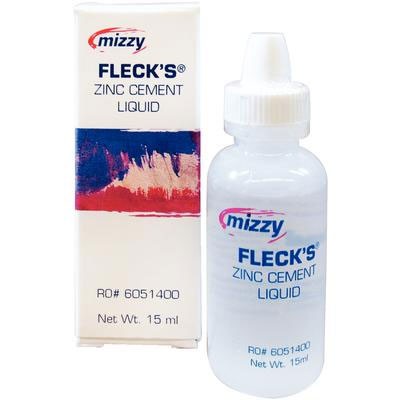 | Dispensing: Liquid Type: Zinc phosphate Fleck's Zinc Phosphate Cement from Mizzy is a traditional cement with a long, trusted clinical history. Although modern adhesive and glass ionomer cements have largely supplanted it, zinc phosphate remains reliable for certain straightforward cases. Why it’s a top pick: Known for excellent compressive strength and a very thin film thickness when mixed properly. Many clinicians still rely on zinc phosphate for full metal restorations or basic crown work where chemical adhesion isn’t necessary. Its simplicity and proven clinical track record make it a staple in many practices. |
Frequently Asked Questions (FAQ)
What is dental cement?
Dental cement is a luting material used to permanently or temporarily attach restorations—such as crowns, bridges, inlays, onlays, and orthodontic appliances—to natural teeth or implants. Depending on the formulation (resin, glass ionomer, resin-modified glass ionomer, zinc phosphate, or temporary cement), it can provide mechanical retention, chemical adhesion, fluoride release, or short-term stabilization.
How long does dental cement last?
The longevity of dental cement depends on the type used and the clinical situation.
Permanent dental cement (such as resin or RMGI) is designed to last many years—often the life of the restoration if properly placed.
Temporary dental cement typically lasts a few days to several weeks, depending on occlusion, fit, and patient habits.
Temporary cement is not intended for long-term use and should be replaced with definitive cementation as soon as possible.
How to remove dental cement?
Removal depends on whether the cement is temporary or permanent:
Temporary cement: Usually removed mechanically with hand instruments or gentle crown removal techniques. It is designed to break down more easily.
Permanent cement: Requires professional removal using rotary instruments, ultrasonic scalers, or crown removal devices. Removal may involve sectioning the restoration in some cases.
Patients should never attempt to remove permanent dental cement at home. Any loose restoration or excess cement causing discomfort should be evaluated by a dental professional.